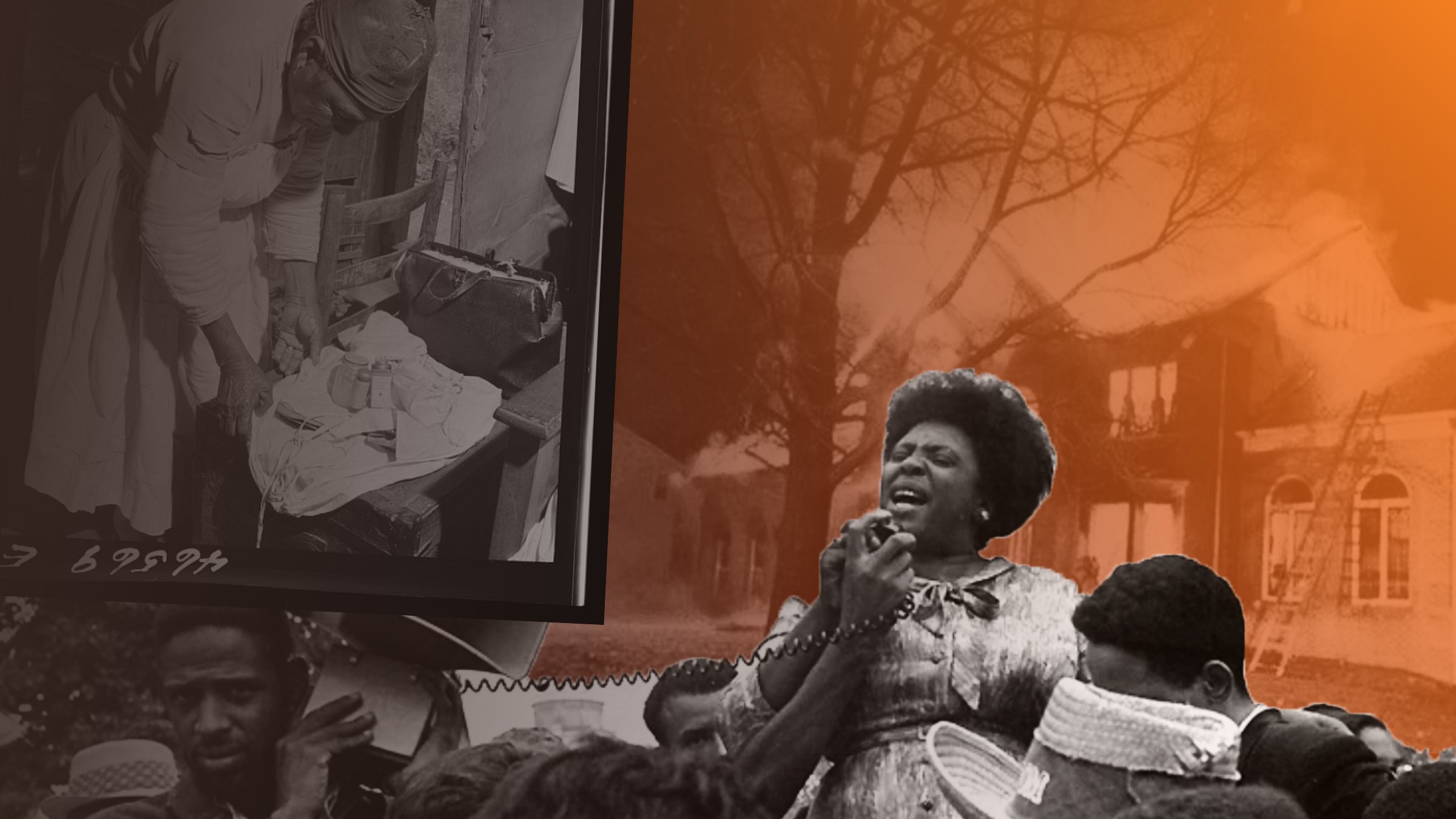
Birthing
in the Fire
On racism and reproductive health in America.
A 70-minute workshop with an 80-page companion workbook, designed to deepen understanding of how history, structure, and lived experience shape Black maternal health outcomes in the United States.
About the workshop
A focused, intentional deep dive into the context that helps explain why disparities exist — and why they persist.
This workshop explores racism in reproductive health in the United States, with a focus on Black maternal health disparities, obstetric racism, and the structural factors that shape pregnancy and birth outcomes. It is an invitation to examine reproductive health through a structural lens — one that accounts for history, policy, and the cumulative conditions that shape pregnancy, birth, and postpartum experiences today.
This is not a comprehensive account of everything that could be said. It is a focused, intentional deep dive into the context that helps explain why disparities exist — and why they persist — and perspectives on what we can do to combat them.
Why this workshop exists
Pregnancy and birth cannot be understood — or improved — without reckoning with who is kept safe and who is put at risk.
Birthing in the Fire™ creates space to examine how historical and ongoing systems of harm show up in reproductive health, why mistrust of medical institutions is evidence-based rather than irrational, and how lived experience becomes biology over time.
It is designed to build shared understanding, responsibility, and clarity about what dignified, equitable care actually requires. By grounding the conversation in history, data, lived experience, and proven models of care, it equips participants to engage this work with honesty, humility, and sustained commitment — recognizing that meaningful change is possible, but will not come to pass on its own.
Who this is for
For those ready to move beyond surface-level conversations.
Birthing in the Fire is for birth workers, healthcare professionals, educators, students, advocates, and organizational leaders willing to engage honestly with how racism shapes reproductive health in the United States. It is designed for people who want to build the capacity to understand history, sit with complexity, and take responsibility for how care is practiced, funded, and structured.
It is especially relevant for those working in perinatal spaces who want to deepen their ability to offer dignified, equitable care grounded in evidence, lived experience, and accountability.
What this workshop covers
From the origins of harm to the shape of accountability.
Across both the video and the companion workbook, the material builds across time — tracing how the past becomes the present, and where responsibility begins.
The role of dehumanization in shaping early systems of care
How power adapts across time to maintain unequal outcomes
The structure of caste, white supremacy, and racism in the U.S.
Weathering, and cumulative stress exposure over a lifetime
The history of medical racism and reproductive harm
A deeper understanding of obstetric racism
Real-world case studies that illustrate pattern, not exception
What responsibility and action look like in practice
About the facilitator
Cheyenne Varner
Founder, The Educated Birth
Cheyenne Varner is a childbirth educator, birth and postpartum professional, and the founder of The Educated Birth, an organization dedicated to making evidence-based, historically grounded birth education more accessible.
Her work explores the intersection of reproductive health, history, structural racism, and systems change, translating complex research into practical education for birth workers, healthcare professionals, and families. Since 2020, she has facilitated trainings on racism and reproductive health that help participants better understand not only what disparities exist, but why they persist — and what it takes to meaningfully address them.
Cheyenne collaborated with Dr. Dána-Ain Davis to create visual educational tools illustrating the dimensions of obstetric racism and illustrated Dr. Karen A. Scott’s SACKRED framework for the CDC Museum’s Health is a Human Right: Achieving Health Equity exhibition. From 2023–2025, she served as a grantee of SisterSong, supporting community-centered reproductive justice initiatives. In 2025, she was named a Richmond History Maker for her contributions to promoting healthy communities. Her work has also been recognized by the National Perinatal Task Force, which designated The Educated Birth an Official Perinatal Safe Spot, and through collaborations with organizations including the National Black Midwives Alliance, the Southern Birth Justice Network, and others.
Through her teaching, writing, and visual education tools, Cheyenne is committed to helping birth workers and healthcare professionals better understand the historical and structural forces that shape reproductive health — and the role each of us can play in creating more equitable systems of care.
Sliding scale access
Choose the price that fits your capacity.
This workshop is offered on a sliding scale to support broader access while sustaining the work behind it. If a lower price point makes it more accessible to you, please select that option — no proof of need or justification is required.
Supported rate
$75
Access without barriers
For those who would not be able to access this workshop without a lower price point.
Get access — $75Standard rate
$100
The full price
For those able to pay the full price of the workshop.
Get access — $100Pay it forward
$150
Sustain the work
Supports the sustainability of this work and helps make lower pricing available to others.
Get access — $150A portion of every purchase supports The Educated Birth Foundation, a 501(c)(3) expanding access to reproductive health education and resources.
Free companion exhibition
The history, made visible.
Seventeen interactive chapters on the history and present of reproductive health equity. Free to browse.
Browse the exhibition →Frequently asked
Questions, answered.
Who is Birthing in the Fire for? +
It’s for birth workers, healthcare professionals, educators, students, advocates, and organizational leaders willing to engage honestly with how racism shapes reproductive health in the United States — anyone ready to move beyond surface-level conversations and build the capacity to offer more dignified, equitable care.
What’s included with access? +
A 70-minute workshop video, an 80-page companion workbook, and a full transcript for accessibility, reference, and continued learning.
How do I access the workshop after I purchase? +
At checkout you’ll set up an account. From then on you can log in any time to stream the workshop and open the workbook and transcript — revisit the material as often as you like.
How does the sliding scale work? +
The workshop is offered at three price points — $75, $100, and $150 — so you can choose what fits your capacity. If a lower rate makes it accessible to you, select it; no proof of need or justification is required. Paying the standard or Pay It Forward rate helps sustain the work and keep lower pricing available to others.
Can I use this with my team, class, or organization? +
Individual access is licensed for one person. For group viewing, organizational licensing, classroom use, or live facilitation, please reach out to the team to arrange appropriate access.
Does purchasing support anything beyond the workshop? +
Yes. A portion of proceeds supports The Educated Birth Foundation, a 501(c)(3) organization dedicated to expanding access to reproductive health education and resources for communities and organizations.
What are the full usage and licensing terms? +
Access to this workshop and its accompanying materials is granted for individual use only. By purchasing or accessing this content, you are granted a limited, non-transferable license to view the workshop and use the materials for your own personal or professional development. This license does not permit sharing, reproduction, redistribution, recording, public display, or facilitation of this material with others — whether in part or in full — without prior written permission.
This includes, but is not limited to:
- Screening the video in group settings
- Sharing the recording, transcript, or workbook with colleagues, teams, or clients
- Uploading or distributing the content on external platforms
- Incorporating the material into trainings, presentations, or curriculum
If you are interested in using this workshop within an organization, training program, classroom, or group setting, institutional licensing and live facilitation options are available. Please reach out to discuss appropriate use and access.
All content remains the intellectual property of Cheyenne Varner and The Educated Birth, LLC, unless otherwise credited. Unauthorized use or distribution may result in legal action.